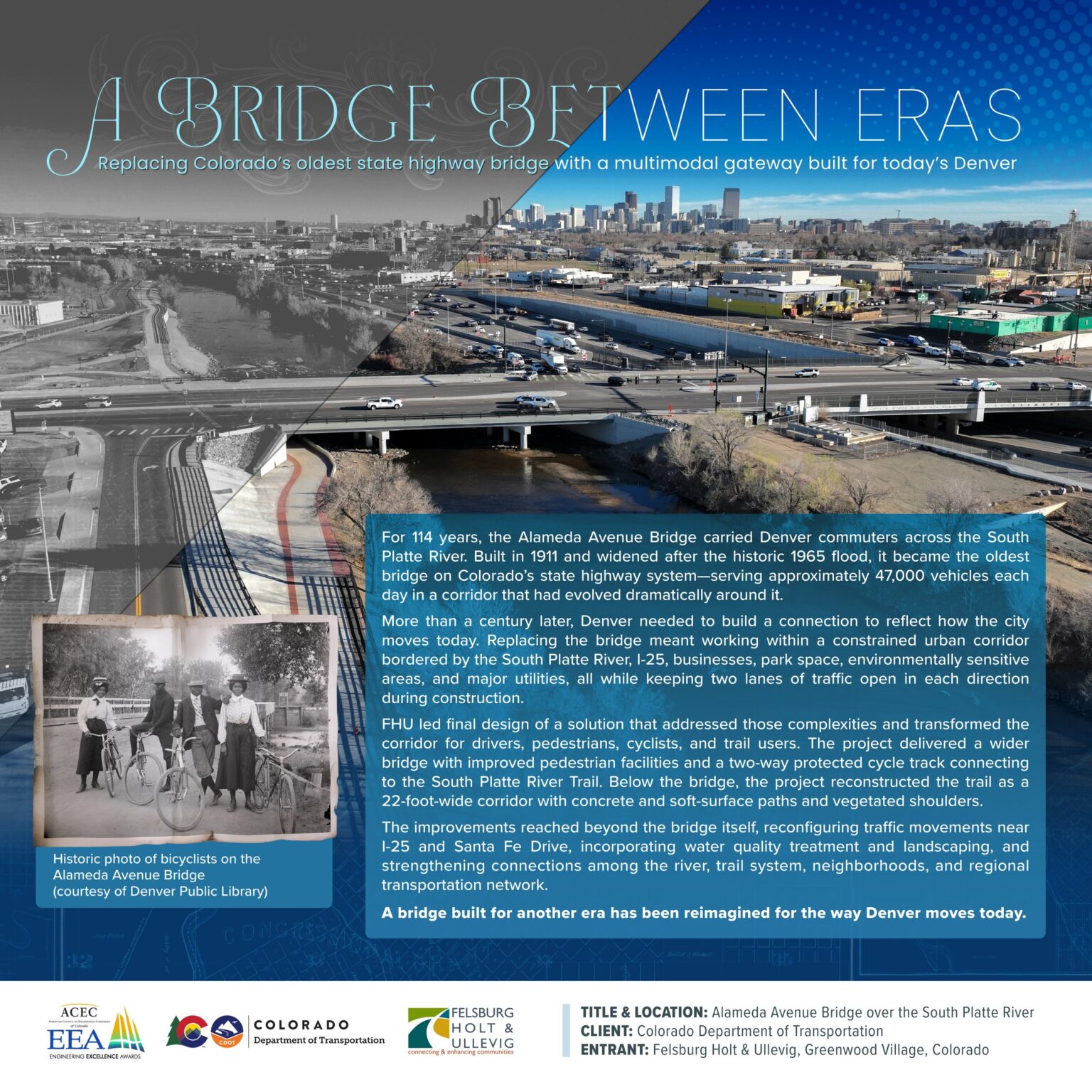
PROBLEM: Recent improvements by the Colorado Department of Transportation (CDOT) to I-25 and the Alameda/Santa Fe Interchange enhanced operations along Colorado’s busiest transportation corridor. Despite these investments, a critical bottleneck remained on West Alameda Avenue: the 114-year-old Alameda Bridge over the South Platte River, the oldest bridge on the Colorado State Highway System, continued to limit safety, mobility, and multimodal connectivity. SOLUTION: CDOT retained Felsburg Holt & Ullevig (FHU) to deliver design and environmental clearance for a comprehensive corridor modernization project. The project included replacement of the Alameda Bridge over the South Platte River; reconstruction of Alameda Avenue between Lipan Street and Santa Fe Drive; reconstruction of Lipan Street between Alameda Avenue and West Cedar Avenue; construction of a protected cycle track along Alameda Avenue; development of a regional water quality facility; and widening of the South Platte River Trail on both sides of Alameda Avenue. The project’s complexity extended far beyond bridge replacement. Situated within a highly constrained urban corridor, the project required balancing transportation, environmental, recreational, floodplain, and community needs while maintaining connectivity through a heavily traveled roadway network. FHU also supported CDOT through the National Environmental Policy Act (NEPA) reevaluation process, addressing impacts to historic resources, parklands, SB40-protected trees, biological resources, and hazardous materials. Successful project delivery required extensive coordination among numerous stakeholders, including the City and County of Denver’s Transportation and Mobility, Parks and Recreation, Forestry, and Floodplain Management groups. Key considerations included traffic signal design, maintenance of traffic during construction, South Platte River Trail improvements, tree mitigation, and floodplain permitting. Coordination with the Mile High Flood District was particularly critical to integrate a regional water quality facility that will provide long-term water-quality benefits while supporting future maintenance objectives. The project also required close collaboration with the City and County of Denver’s consultant team for the adjacent South Platte River Trail–Virginia to Bayaud Project to ensure seamless integration of trail widening improvements and intersection enhancements at Alameda Avenue and South Platte River Drive. Completed in June 2025, the project eliminated a critical corridor bottleneck and replaced infrastructure from another era with a safer, more resilient connection designed to serve how the Denver region moves today and into the future.