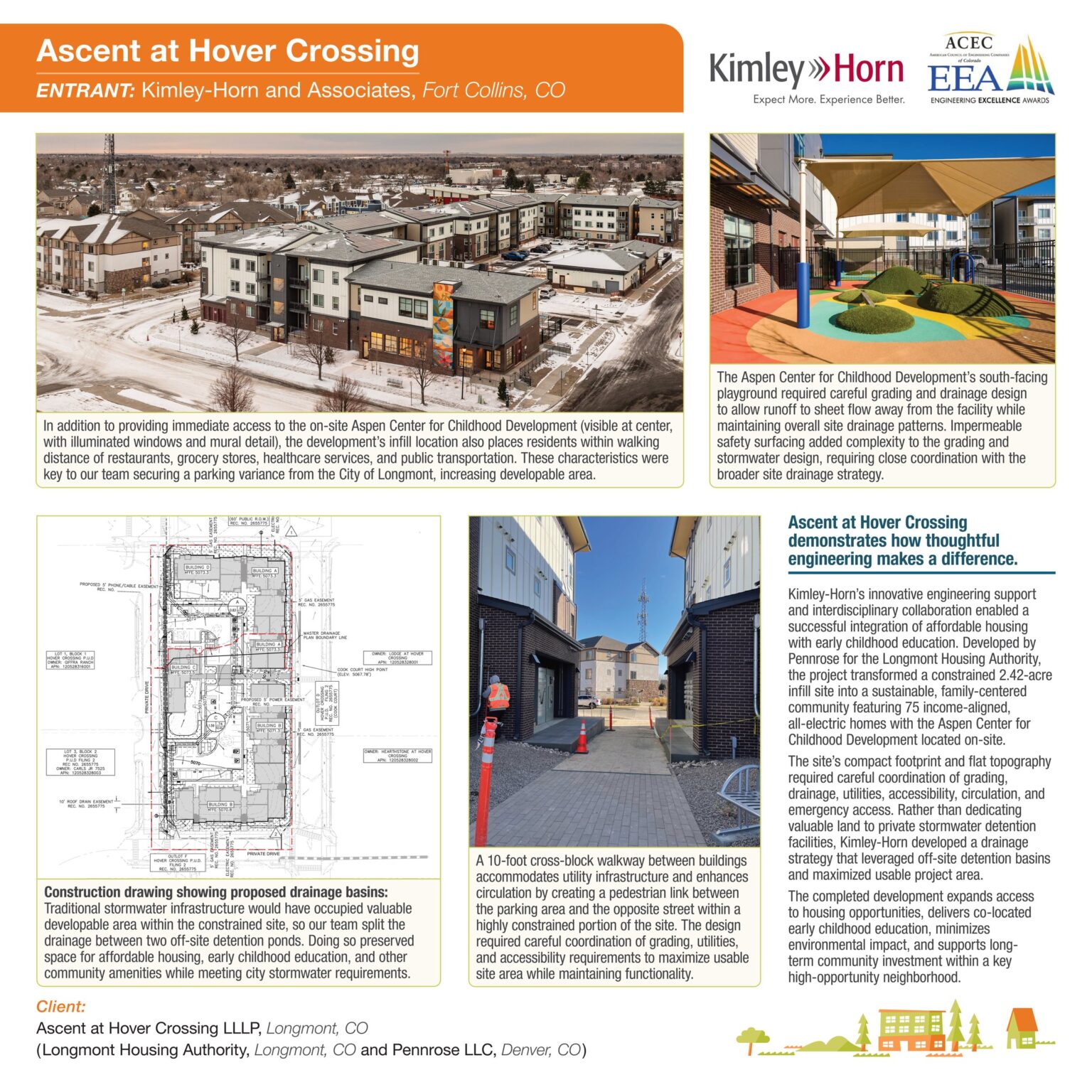
Ascent at Hover Crossing addresses two challenges affecting many Colorado families: the need for affordable housing and access to quality childcare. Developed through a partnership between Longmont Housing Authority (LHA) and Pennrose, the $38.9 million project transformed 2.42 acres of constrained infill land in Longmont, Colorado, into a family-centered community with 75 income-aligned homes, the Aspen Center for Childhood Development, playgrounds, resident amenities, and rooftop solar infrastructure. The development serves households earning between 30% and 80% of Area Median Income (AMI) and provides 27 three- and four-bedroom homes, representing 36% of the community and directly responding to the need for familysized rental homes. The project goals were clear, but the nature of the project and the site itself made delivery difficult. The relatively flat and compact property needed to accommodate residential buildings community amenities, an integrated early childhood education (ECE) center with a south-facing playground, adequate parking, utility infrastructure, emergency access and accessible routes, and landscaping and stormwater requirements within a limited footprint. In addition, the team had to be flexible and repeatedly adjust plans to accommodate different ECE funding requirements while LHA and Pennrose pursued the grants needed to make that aspect of the project possible. Kimley-Horn’s solution to these challenges centered on effective stakeholder coordination and using civil engineering as a site-efficiency strategy. Rather than allowing stormwater infrastructure to occupy valuable land, our team developed a grading and drainage approach that routed 100% of site runoff to two regional basins, avoiding the need for on-site detention. Because the site relied heavily on surface sheet flow, we had to confirm that building locations, sidewalks, parking areas, playgrounds, finished floor elevations, utility routes, and accessible circulation all worked together effectively. We also coordinated with the city engineer in two key ways to maximize developable area: (1) meeting water quality treatment requirements by incorporating vegetated buffer areas before discharging runoff into the public right-of-way and (2) securing a reduced parking requirement because the project met affordable housing targets and had nearby street parking and public transportation options. This integrated approach finding tailored solutions preserved usable site area for affordable housing, ECE, playgrounds, circulation, utilities, and other community-serving components. The completed project demonstrates innovation, complexity, and value by combining affordable housing with ECE, stormwater management, sustainability, and community investment within one constrained site. The 211-kW rooftop solar installation supports the City of Longmont’s Iluminar Community Solar program, and is expected to reduce residents’ electric utility costs by up to 50%. By turning technical constraints into coordinated design solutions, Ascent at Hover Crossing offers a replicable model for how engineering can help other communities make limited land work harder, expand opportunities for working families, and deliver lasting social, economic, and sustainable community benefits.