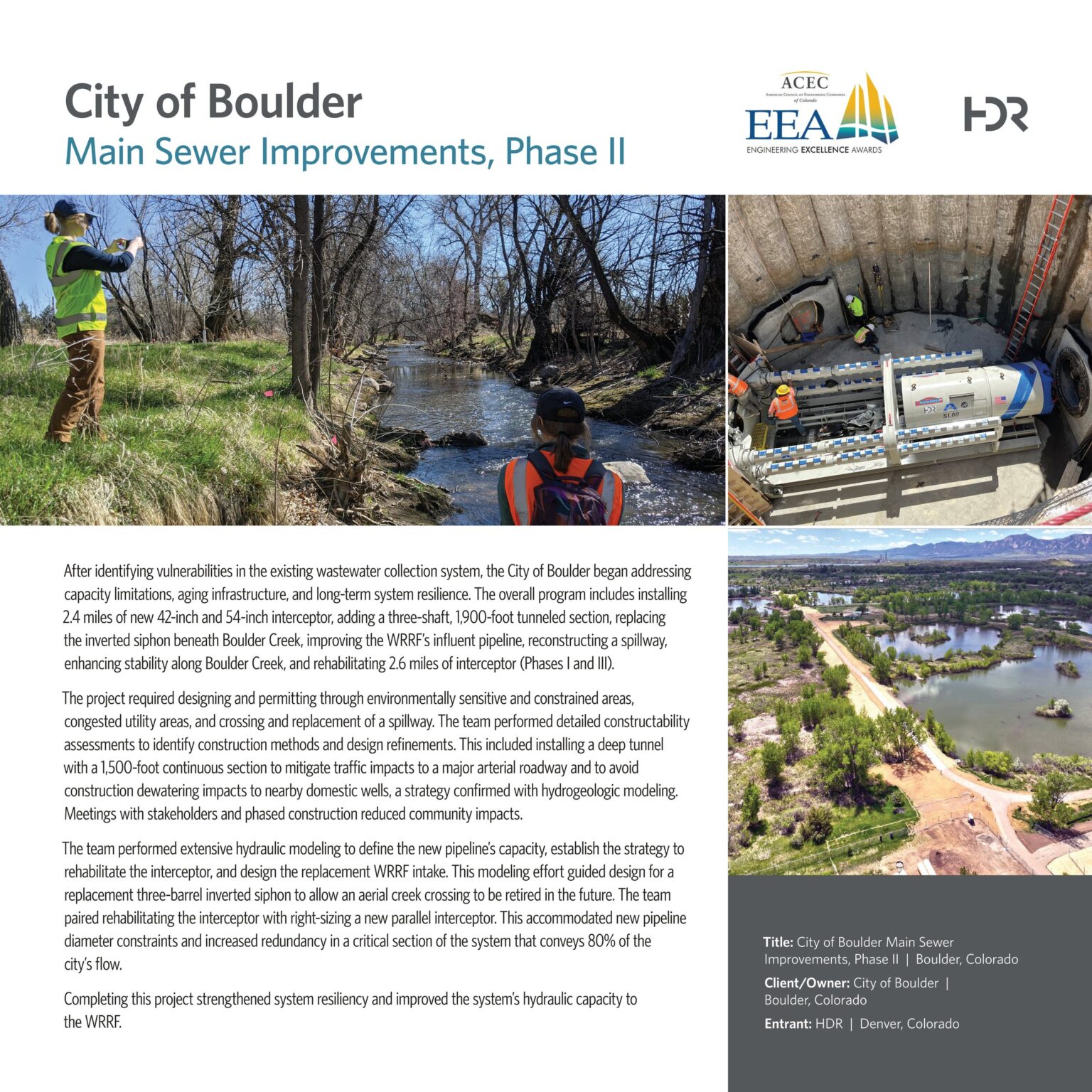
The City of Boulder’s Main Sewer Improvements project addressed capacity limitations, aging infrastructure, and long-term system resilience needs for the city’s primary wastewater conveyance corridor to the city’s water resource recovery facility (WRRF). The overall program includes installing 2.4 miles of new 42-inch and 54-inch interceptor, adding a three-shaft 1,900-foot tunneled section, replacing the inverted siphon beneath Boulder Creek, improving the WRRF’s influent pipeline, reconstructing a spillway, enhancing stability along Boulder Creek, and rehabilitating 2.6 miles of existing interceptor (Phases I and III). The project team performed extensive hydraulic modeling to define the new pipeline’s capacity, establish the program strategy for rehabilitating the existing interceptor, and to iteratively design the replacement WRRF intake. This modeling effort guided the design of a replacement three-barrel inverted siphon to potentially allow for a phased retirement of a critical aerial crossing of Boulder Creek. The team strategically paired rehabilitating the interceptor with right-sizing a new parallel interceptor. This accommodated new pipeline diameter constraints and increased redundancy in a critical section of the system that conveys 80% of the city’s flow. The project required design and permitting through environmentally sensitive and constrained areas that included creek and wetland adjacency, shallow cover, congested utility areas, and construction along a spillway. The team performed detailed constructability assessments at each critical section to identify construction methods and refine the design. This included the decision to install a deep tunnel with a 1,500-foot continuous section to mitigate traffic impacts to a major arterial roadway and to avoid construction dewatering impacts to nearby domestic wells, a strategy confirmed with hydrogeologic modeling. The team met with key stakeholders and established a phased construction schedule to reduce construction impacts to the community. Completing this project strengthened system resilience and improved the system’s hydraulic capacity to the WRRF. EXECUTIVE SUMMARY