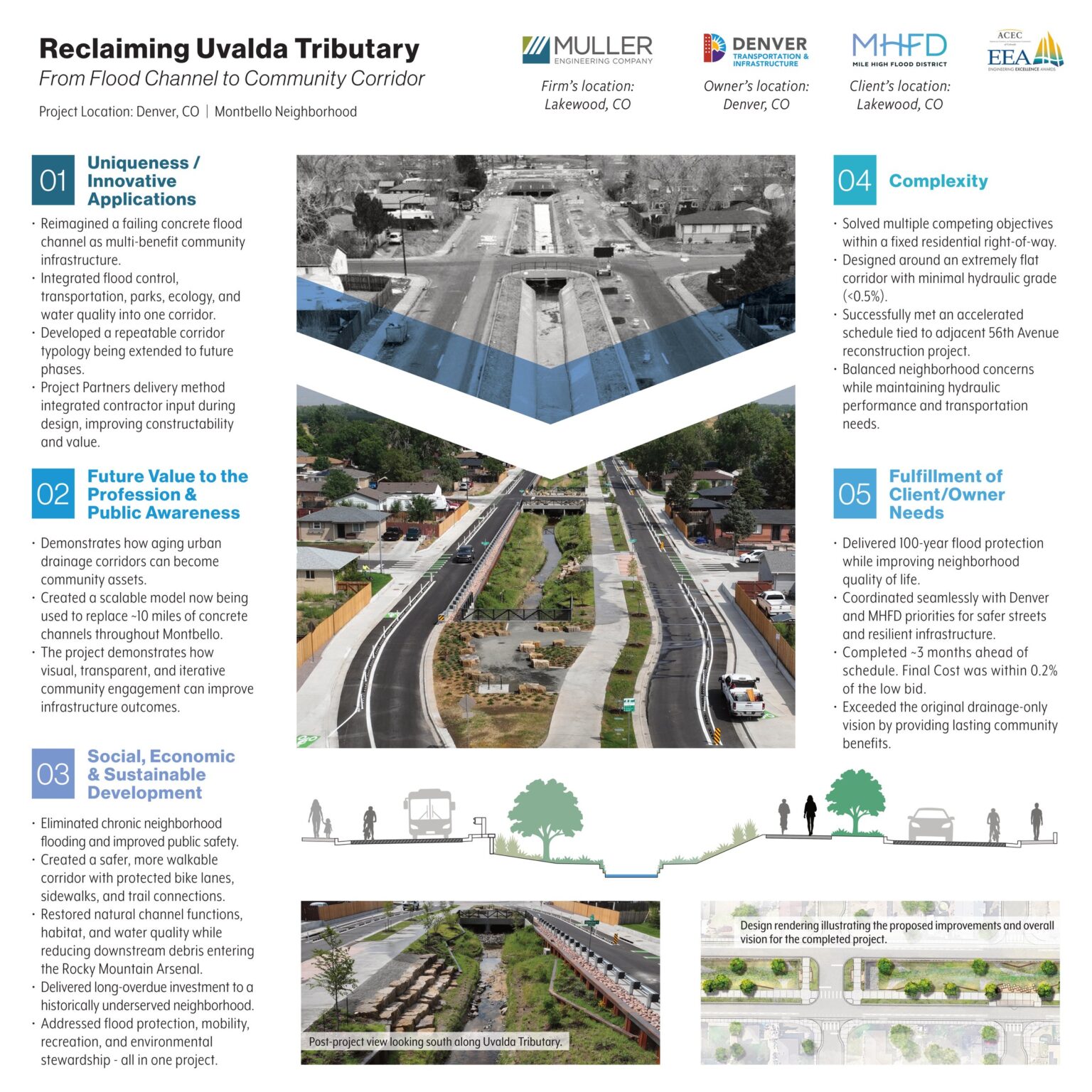
For decades, the Uvalda Tributary in northeast Denver was little more than aging infrastructure: a deteriorating concrete drainage channel with recurring maintenance problems, limited ecological value, and few benefits for the surrounding Montbello neighborhood beyond conveying stormwater. A significant 2018 storm brought the corridor’s drainage deficiencies into sharper focus, reinforcing years of neighborhood planning that had identified the need for flood protection, safer streets, and meaningful infrastructure investment. The Reclaiming Uvalda Tributary project answered those needs by transforming a failing, singlepurpose drainage corridor into a resilient community asset that reduces flood risk while improving mobility, ecology, recreation, and neighborhood connectivity. The Problem and the Challenges: What began as a necessary stormwater project quickly became a much more complex undertaking. The existing concrete-lined channel was deteriorating and hydraulically constrained, while the corridor’s approximately 0.5% longitudinal slope provided almost no flexibility for channel grading, storm drain elevations, roadway tie-ins, and utility crossings. At the same time, the design needed to improve pedestrian and bicycle safety, maintain roadway and emergency access, restore ecological function, coordinate with numerous agencies and utilities, and remain synchronized with the adjacent 56th Avenue reconstruction project. Reclaiming Infrastructure for the Community: Muller Engineering Company (Muller) led a multidisciplinary team that looked beyond simply replacing the concrete channel. Instead, the project reimagined how one infrastructure investment could accomplish many community goals at once. Key solutions include: • Resilient Stormwater Infrastructure: The project provides conveyance of the full 100-year storm flow beneath 56th Avenue while reducing localized neighborhood flooding during smaller storms. A naturalized stream system, two water quality ponds, 1,778 feet of storm drain, a new outfall, bioengineering, and a debris and sediment collection area improve water quality and long-term resilience. • A Safer Multimodal Corridor: Approximately 0.4 miles of bicycle lanes, sidewalks, and trail connections replace a vehicledominated corridor with one designed for people. Traffic calming, narrowed travel lanes, increased pedestrian separation, and a roundabout improve safety while maintaining essential access. • A New Connection to Nature: A new multipurpose trail gives the neighborhood its first formal direct connection to the Rocky Mountain Arsenal National Wildlife Refuge while connecting with broader community initiatives such as the FreshLo Loop. • A Corridor Designed to Be Repeated: Rather than creating a one-off solution, Muller developed a scalable cross-section that can extend into future phases throughout Montbello. The approach is already being applied to the next upstream segment, establishing a practical model for reclaiming other concrete drainage channels in the neighborhood. Community-Centered Collaboration: The transformation was shaped through close coordination with the Mile High Flood District, City and County of Denver, Denver Water, U.S. Fish and Wildlife Service, utility providers, regulatory agencies, the contractor, and community stakeholders. Workshops, public meetings, City Council briefings, conceptual renderings, and phased planning graphics helped residents understand complex engineering decisions and provided opportunities for community priorities to influence the design. The result delivers benefits far beyond traditional flood control. Residents experience reduced flood risk along with safer walking and bicycling, improved neighborhood connections, expanded vegetation and shaded spaces, new recreation and gathering opportunities, and direct access to a major regional natural resource. In a neighborhood that historically received limited infrastructure investment, the project demonstrates how essential public works can simultaneously improve safety, resilience, health, and quality of life. Efficient, Collaborative Delivery: Through Mile High Flood District’s Project Partners delivery approach, the contractor joined the team during final design to provide real-time cost estimating, value engineering, constructability input, and schedule coordination. This approach helped synchronize construction with the adjacent 56th Avenue project and minimize prolonged disruption to residents. The $16.9 million project was completed September 25, 2025—three months ahead of schedule—with final construction cost remaining closely aligned with the $16.47 million engineer’s estimate. Why This Project Deserves Recognition: The Reclaiming Uvalda Tributary project demonstrates how a holistic, multi-purpose design can be implemented. A deteriorating concrete channel became flood protection, a naturalized stream, a safer street, a trail, a neighborhood gathering place, and a new connection to the Rocky Mountain Arsenal, all within one coordinated investment. Just as importantly, the transformation does not end at the project limits. The corridor establishes a repeatable model already informing future Montbello improvements. Reclaiming Uvalda Tributary shows that engineering excellence is not simply replacing what has failed; it is recognizing the greater opportunity within that investment. By integrating effective stormwater management, transportation, environmental stewardship, and placemaking, the project redefines aging infrastructure as an investment in people, place, and long-term community resilience. Reclaiming Uvalda Tributary | Executive Summary Category G Water Resources