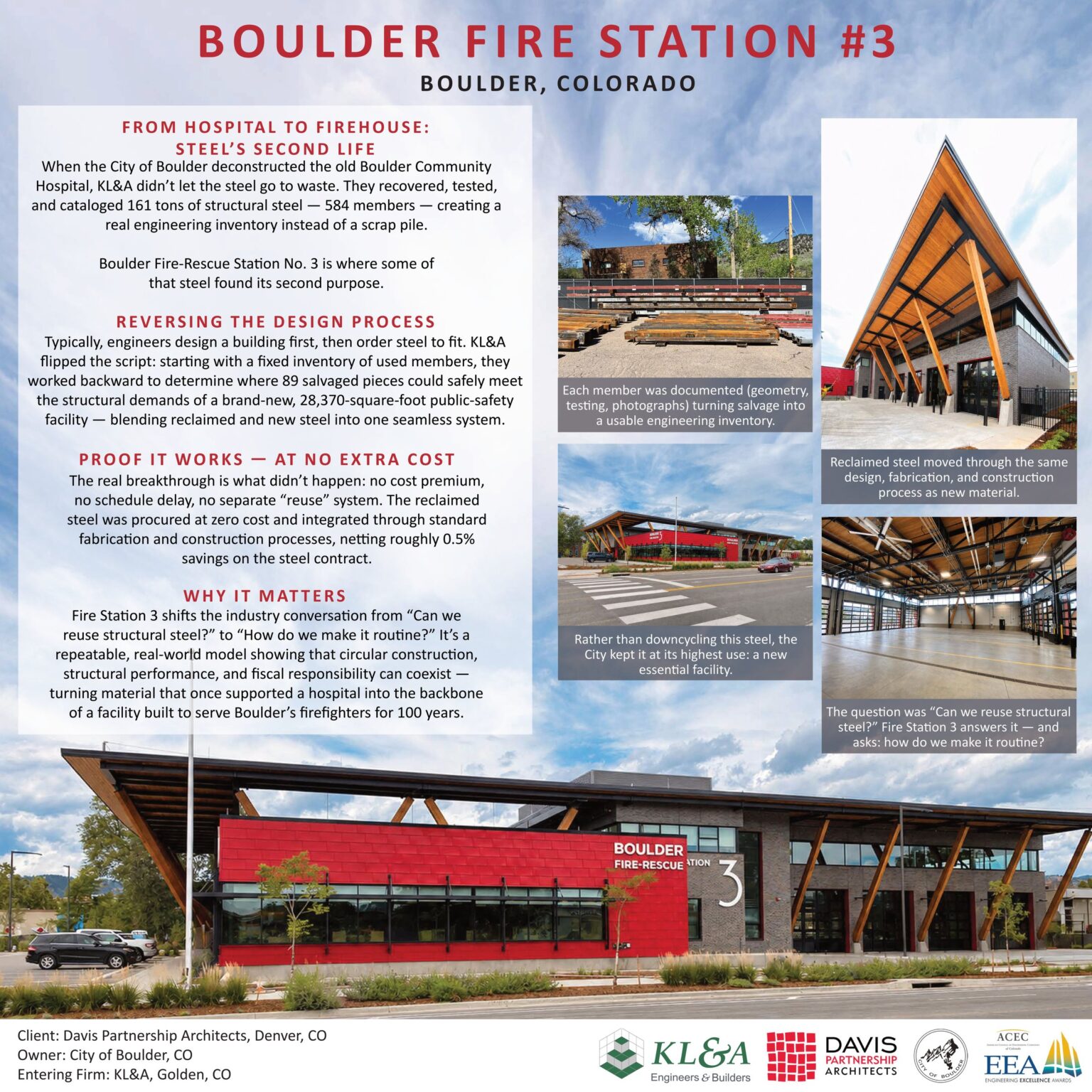
Boulder Fire-Rescue Station No. 3 demonstrates that structural steel reuse can move beyond an ambitious sustainability concept and become a practical, repeatable approach to conventional building design and construction. KL&A Engineers & Builders served as Structural Engineer of Record for the City of Boulder’s new 28,370-square-foot essential public-safety facility. The project builds directly upon KL&A’s previous work on the Boulder Community Hospital Deconstruction and Steel Reuse Project, where approximately 161 tons—584 individual members—of structural steel were recovered, tested, documented and inventoried for future use. Fire Station 3 completed that circularity loop by incorporating 89 reclaimed structural members from the former hospital into the new facility’s primary structural system. The engineering challenge required KL&A to fundamentally reverse the conventional structural design process. Rather than designing the structure and ordering new members optimized for each location, engineers began with a finite inventory of existing steel—each member having predetermined dimensions, material properties, geometry and condition—and determined where those pieces could safely and efficiently meet the structural demands of a completely different building. The result was not a separate “reused” structure. Reclaimed and new steel were integrated into a single coordinated structural system and moved through familiar engineering, documentation, fabrication and erection processes. Perhaps the strongest measure of the project’s success is what didn’t happen: there was no reported fabrication cost premium, installation cost premium or schedule difference associated with the reclaimed steel. The steel itself was provided to the project at no cost. Fire Station 3 therefore represents more than the successful reuse of 89 structural members. It provides the engineering profession with a real-world model for circular construction— demonstrating that sustainability, structural performance, constructability and fiscal responsibility do not have to compete. Material that once supported healthcare operations in Boulder now supports the firefighters and emergency personnel serving that same community. More importantly, the project establishes a repeatable pathway for giving structural materials a second life and advances the industry’s conversation from “Can we reuse structural steel?” to “How do we make reuse routine?”