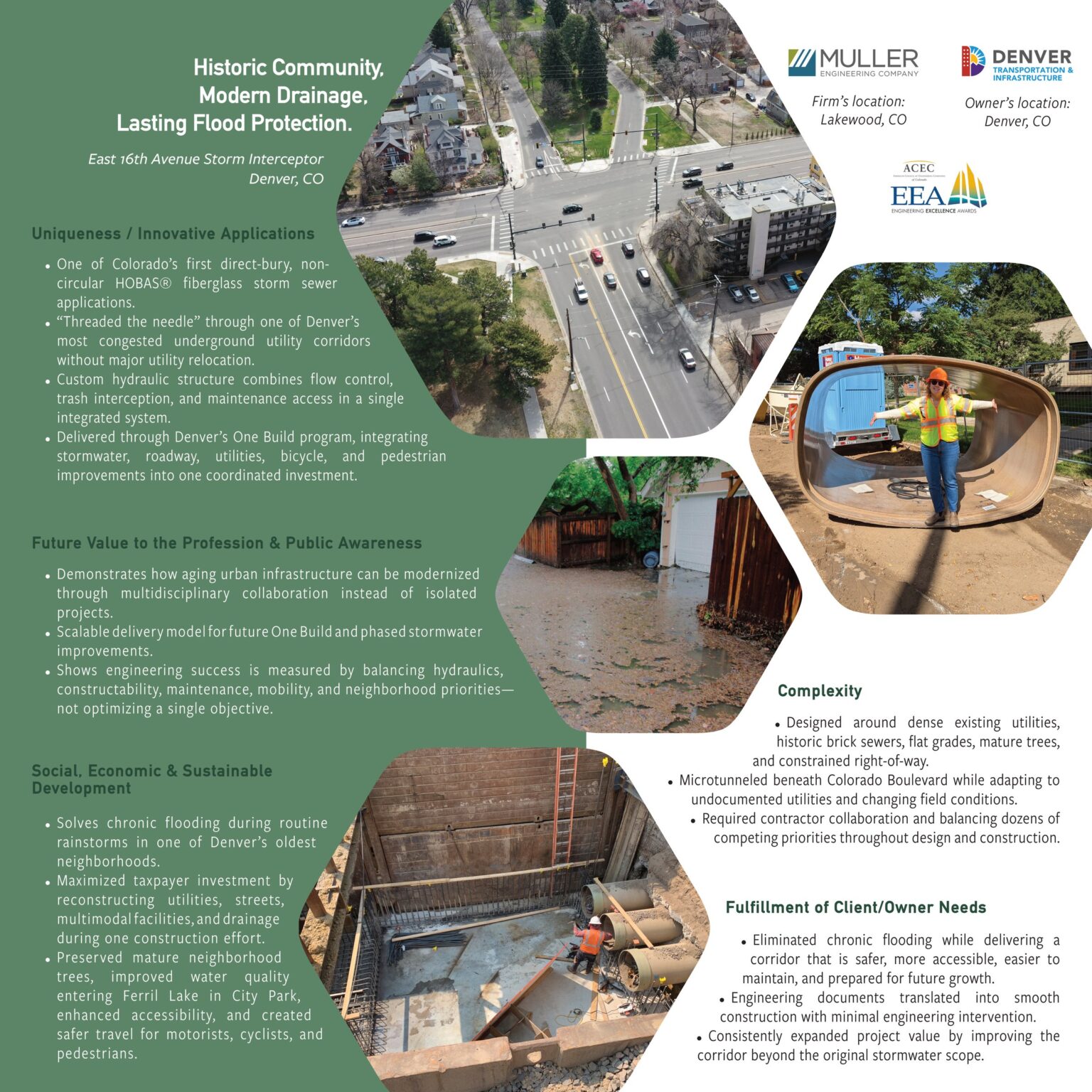
Stormwater infrastructure is rarely noticed when it works. But in one of Denver’s oldest neighborhoods, routine rainstorms have become a recurring source of disruption. Flooded streets affect access to homes and businesses, limit mobility, and create uncertainty every time rain was in the forecast. The East 16th Avenue Storm Interceptor project changed that reality. What began as an effort to solve decades of chronic flooding became a comprehensive reinvestment in the neighborhood, modernizing aging infrastructure while creating safer streets, improved bicycle and pedestrian facilities, upgraded utilities, and a more resilient corridor for generations to come. The Problem and the Challenges: Building a larger storm sewer sounds straightforward until there is virtually nowhere to put it. Beneath the corridor was a dense network of sanitary sewers, water mains, dry utilities, historic brick and clay pipes, and other infrastructure installed across generations. The design navigated approximately 90 utility crossings and conflicts involving seven utility owners, often with only 12 inches of vertical clearance between major facilities, with excavations reaching depths of 20 feet. Above ground, heavily traveled streets, established trees, bicycle and pedestrian routes, homes, and neighborhood amenities further restricted construction. The project team described the challenge simply as “threading the needle” through one of Denver’s most congested underground utility corridors. Customized Solutions Where Conventional Design Could Not Work: Muller Engineering Company (Muller) continually evaluated materials, alignments, construction methods, and hydraulic configurations rather than forcing conventional solutions into an unconventional setting. Key innovations include: • Custom Non-Circular Fiberglass Reinforced Pipe: For three blocks, the project used a custom 110-inch-by-68-inch HOBAS® glass-fiber reinforced pipe, the first Colorado-area direct-bury storm sewer application of its kind. Its shape and lightweight construction provided substantial hydraulic capacity while reducing excavation requirements and helping preserve established neighborhood trees that conventional installation methods would have affected. • Custom Hydraulic Structures: Large vaults were designed to do far more than connect pipes. They redirect flows, combine multiple pipes, improve trash interception before discharge toward Ferril Lake in City Park, and provide centralized access that makes long-term maintenance safer and more efficient. • Microtunneling Through a Constrained Urban Corridor: Approximately 600 linear feet of microtunneling beneath Colorado Boulevard and an additional city block allowed major infrastructure to pass through one of Denver’s busiest areas while limiting surface impacts. • Design That Adapted to Reality: Unknown utilities, unexpected materials, groundwater, and field conditions required continuous refinement of the design. Contractor input and value engineering ultimately produced solutions that reduced structural costs, accelerated installation, and avoided additional utility relocations. Benefits People Experience Every Day: The most important measure of success is what residents no longer experience. The project reduced repetitive flooding affecting approximately 50 homes across 20 acres, intentionally addressing the frequent storms that disrupted everyday life rather than focusing only on rare extreme events. Those benefits extend far beyond stormwater. Approximately 5,500 linear feet of pedestrian and bicycle facilities were upgraded, roadway cross slopes were corrected, a problematic turning movement at Colorado Boulevard and 17th Avenue was eliminated, accessibility was improved, and aging utility infrastructure was modernized. The result is a corridor that works better for motorists, cyclists, pedestrians, maintenance crews, emergency responders, and residents alike. One Construction Effort, Greater Public Value: Through Denver’s One Build initiative, stormwater construction became an opportunity to coordinate roadway reconstruction, utility upgrades, bicycle facilities, pedestrian improvements, and traffic modifications. Instead of repeatedly excavating the same neighborhood for separate capital projects, multiple public investments were delivered through one construction effort, maximizing limited funding while reducing future construction impacts and disruption. Why This Project Deserves Recognition The East 16th Avenue Storm Interceptor project demonstrates that innovation does not always mean inventing something entirely new. Sometimes engineering excellence is the ability to find a way forward when conventional solutions simply will not fit. Beneath the reconstructed streets is a stormwater system carefully threaded through more than a century of infrastructure. Above it is a safer, more accessible, and more resilient neighborhood. Flood risk has been reduced. Community assets were protected. Utilities and transportation facilities were improved. Residents who once prepared for flooding when rain was in the forecast can now experience something far less dramatic and far more valuable: infrastructure that simply works. The project makes engineering’s impact tangible not through what people see, but through the problems they no longer have to experience. East 16th Avenue Storm Interceptor | Executive Summary Category G Water Resources