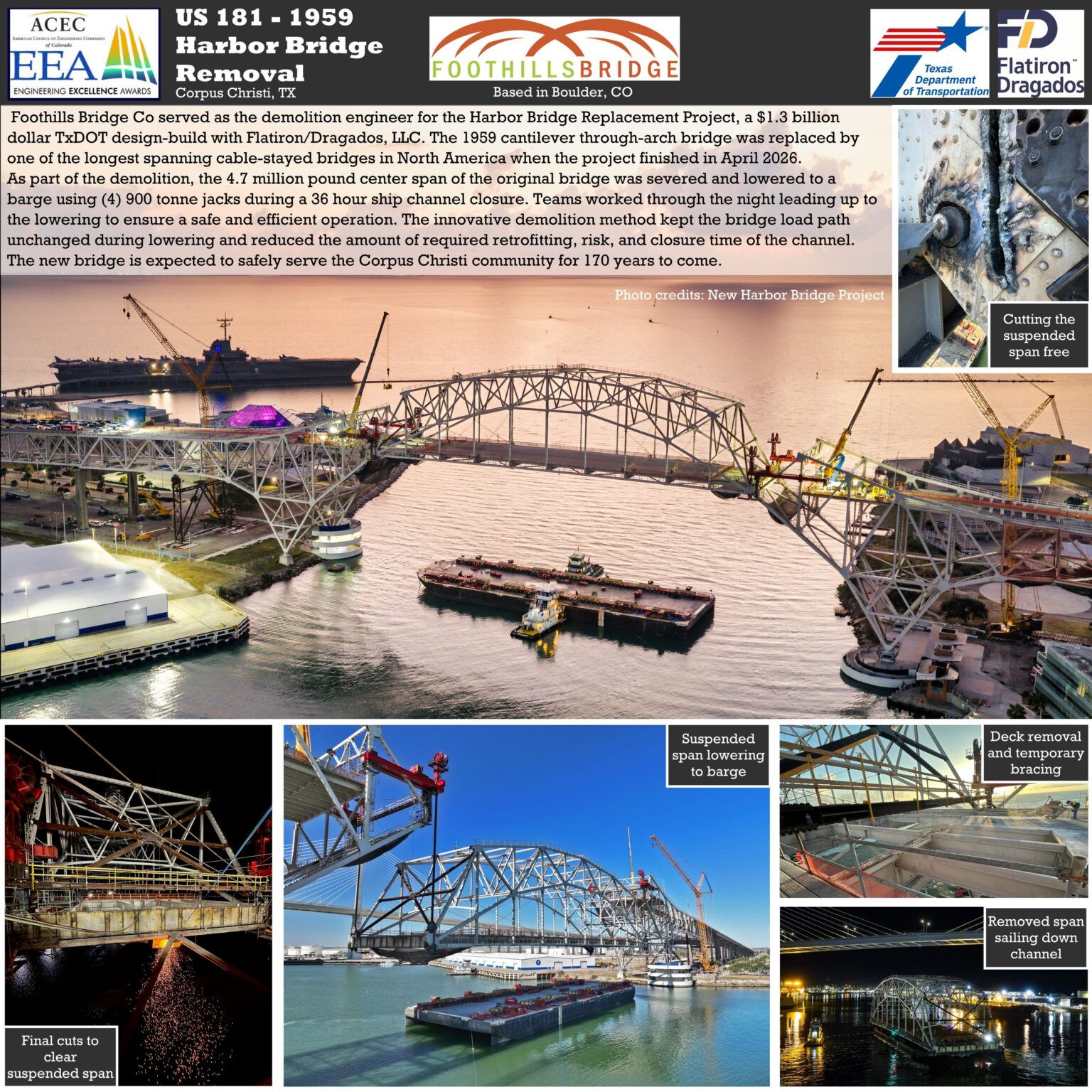
Recruited by project developer Flatiron/Dragados, LLC (FDLLC), Foothills Bridge Co engineered the demolition of the original Texas Department of Transportation (TxDOT) US 181 Harbor Bridge in Corpus Christi, Texas, as part of the overall $1.3 billion bridge replacement project. Finished in 1959 as the largest TxDOT project to date, the bridge carried 6 lanes of tra6ic over the Corpus Christi Ship Channel for nearly 7 decades before being demolished. TxDOT replaced the bridge with a new cable-stayed bridge immediately adjacent to the old bridge location and opened the new bridge to tra6ic in June 2025. Demolition of the old bridge was a complex engineering problem with a multitude of constraints. The bridge approaches bordered several Coastal Bend attractions and straddled one of the largest energy and tonnage ports in North America; the ship channel could only be closed for 36 hours and required weeks of coordination with the Port of Corpus Christi. Furthermore, weather conditions were a significant factor during the bridge removal, slated to occur during hurricane season, and the bridge itself could not support significant heavy equipment loads. The most e6icient way to remove the 4,700kip center span of the bridge was to lower the span with strand jacks onto a barge and float it to an o6site location where the span could be disassembled. This reduced the risk of incident from operations above an active ship channel, limited the required channel closures, and prevented other issues of reaching the main span structural elements with cranes from shore. This method also took advantage of the original 1950s design of the bridge while presenting an opportunity for the project team to use advanced engineered techniques. The original bridge was a cantilever through-arch truss bridge, characterized by a suspended main span that was simply supported by the adjacent cantilevered spans using pin connections in the lower chords. By cutting and lowering the suspended span at the existing pin locations, the load path within the bridge remained largely unchanged and required minimal modifications from its existing condition. To execute the suspended span lowering, four 900-tonne hydraulic strand jacks were stationed on temporary beams installed at the ends of the cantilever spans and connected to the center span near the pin locations. Prior to lowering, a test lift was performed, which raised the suspended span a fraction of an inch, confirming the expected weight and ensuring span movement. The suspended span was severed from the cantilever spans by cutting through the pin connection gusset plates and then carefully lowered to a barge waiting in the channel below. Before lowering commenced, temporary shoring towers were installed under the anchor span trusses to provide support after the weight of the suspended span was removed from the remaining structure. The cantilever and anchor spans were removed with piecemeal crane picks, and the remainder of the bridge was removed by FDLLC using conventional demolition methods. The new bridge opened to tra6ic in June 2025, and the old bridge was o6icially decommissioned and dismantled beginning in October 2025. The project was completed safely with minimal impact to the ship channel and local community, and marked a major success for all stakeholders. All steel from the original bridge was recycled for use in future infrastructure, with some pieces sent to Purdue University to help train future bridge inspectors and engineers. The new bridge is expected to safely carry travelers along the Texas coast for 170 years to come.